In Piedmont, there are many, many enotecha. Wine shops or wine bars are scattered around Alba. But some are more special. Some are designated Enoteca Regionale. They showcase wines from local producers and many are housed in historic buildings or castles like the one I visited Monday.

Above you’ll see the photo of the castle of Grinzane Cavour. Cavour was an Italian statesman and not surprisingly, winemaker, back in the 1800s. The wine shop and tasting are on the first floor. There’s also a restaurant and museum in the building.
Being the first enotecha I’ve been too like this one I wasn’t entirely sure what to expect. I found this first one to be surprisingly large, and open. A woman at a counter up front greeted me and led me to one of several tasting bars. While there are literally hundreds of regional wines available on shelves to buy, on any given day what they will be tasting will be limited to a few selected bottles. On the day I arrived there was one Arneis, some red table wines I didn’t specifically make a note of and then three Barolo, a couple Barberesco and a Langhe Nebbiolo.
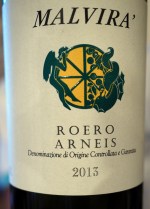
The photos here are of the ones I tried. First up, the Roero Arneis. The Roero is a wine region located to the north of Alba. It’s a crisp white wine that’s a little floral on the nose. Very refreshing and something nice to start with.
Up next the Langhe Nebbiolo. The Langhe is the hilly around and south of Alba. See my photo included at the bottom here. Everywhere you look, the hillsides are covered with vineyards. Much of it is Nebbiolo, which is the grape in all three of the red wines I tasted here.
The Langhe Nebbiolo was very nice. In fact, the favorite of the three I tried here. It was a rich red wine with an excellent structure though not too tannic. Lots of dark berry and cherry on the taste. Details here. The woman that was helping me with the tasting made a point of telling me this wine had what I gathered was a special designation from the ‘Ordine dei Cavalieri del Tartufo e dei Vini di Alba’ (in fact the back label includes the award designation … I wouldn’t have otherwise remembered that name.) That’s the Italian way of saying: the Order of the Knights of the Truffle and Wines of Alba. I don’t know how much of such a distinction gets you but she seemed to think it was worth mentioning.
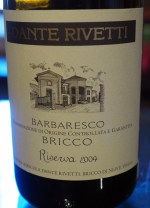
Next was on to the Barbaresco. Also of Nebbiolo, the wine can be a ‘Barbaresco’ if it’s produced in one of three towns: Barbaresco, Treiso and Neive. More on those places later. I headed in that direction on Tuesday. It also has to be aged at least two years (1 on oak).
Of the three, this Barolo was much more tannic than the other two. Which is interesting because after the fact I found a web site with information from the producer and it says the La Serra comes from soil and microclimate that produces “never excessive tannins”. (Even the knowledgable woman helping me that day said this was the most tannic of the wines I was trying that day. She also mentioned this as a young wine. She told me the year but I didn’t make note of it and it’s not evident on the photo I took.)
Like the Barbaresco, to be called a Barolo the wine has to have come from designated areas in and around Barolo. The number of towns is larger but the vineyards are those selected with the best soil and orientation. Additionally, the wine must be aged a min of 3 years.
For me, the Barolo would have been a lot better had I been having it with some meat or aged cheese.
As you can see, the weather was great that day and I just wandered the grounds for a bit and took pictures of the area. In every direction, it looked very much like the photo below. And seeing all these hills, my mind began to wander to the bike tour of the next week. Gonna be a lot of hills to climb.




 Rambling Roads